
81 years ago this week: Remembering “Little Boy” and “Fat Man”
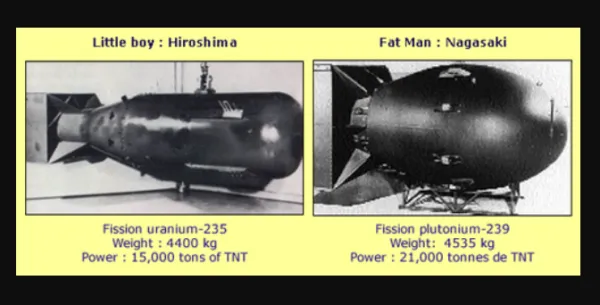
The Little boy and Fat man bombs dropped on Japan. Photo by ShanekPPS
The second week of August 1945 is one that was indelibly etched in the minds of those that Tom Brokaw immortalized in his book The Greatest Generation. It has also been the subject of numerous documentaries, movies, and one of the most studied acts of war in 20th century history, foreign affairs, political science/international relations and comparative politics.
On Monday, August 6, 1945, the United States became the first nation to use nuclear weapons, “Little Boy,” against another country and in so doing forever altered the worlds’ geopolitical landscape in myriad ways. In the days leading up to the history making move on July 26, 1945, at the Potsdam Conference, President Harry Truman, Prime Minister Winston Churchill and President Chiang Kai-shek of China announced the Potsdam Declaration, which laid out in bold relief the terms of Japan’s surrender. This ultimatum stated if Japan did not surrender, it would face “prompt and utter destruction.”
Japan’s Emperor Hirochito was unmoved prompting the United States to do what many considered unthinkable. It dropped “Little Boy” leaving unspeakable amounts of carnage in its wake. No fewer than 70,000 people, mainly civilians, in the Japanese city of Hiroshima were killed instantly. This unprecedented move led to an arms race with the former Soviet Union.
For a short time, America was the world’s lone superpower (if indeed that term was in vogue back then), that is until the Soviets built their own atomic bomb four years later in 1949. One unintended consequence of America’s acquisition of the bomb was the breakdown of the U.S.-Soviet alliance. Because the Soviets were kept in the dark about America’s bomb-building plans the Soviets felt they could no longer trust the Americans; this resulted in a decades long freeze commonly known as the Cold War.
Later that week, Thursday, August 9, a bomb code name “Fat Man” was dropped on Nagasaki killing between 35,000-40,000 people on impact. Historians claim the decision to resort to nuclear warfare was to avoid a costly land invasion which military officials surmised would claim hundreds of thousands of Allied lives and millions of Japanese citizens. The move hastened Emperor Hirochito to wave the white flag on August 15, thus ending years of devastation and one could argue unnecessary global conflict.
There has been much debate over the years as to whether the bombings were necessary to force Japan to surrender. Some say yes, while others say no. Opponents of nuclear war maintain that America’s actions were immoral and a crime against humanity. They argue that Japan was on the verge of surrendering anyway prompted by the USSR’s invasion of Manchuria, Sakhalin and Kuril Islands, something that the Japanese absolutely did not want but felt helpless to prevent. Opponents of the use of the atomic bomb also contend that a naval blockade and conventional bombings would have been enough to bring Japan to its knees. Supporters of nuclear warfare argue that the planned invasion of Kyushu in November and Honshu in March by the U.S. and their allies would have resulted in unimaginable losses of life. They also maintain that “Little Boy” and “Fat Man” were not only the better options because of fewer casualties, but because the bombings brought an end to World War II.
What is beyond dispute however is the tremendous loss of life in Japan that week; that it took at least a decade to return Nagasaki and Hiroshima to their pre-World War II state and that the use of nuclear warfare ushered in (perhaps not for the better) a new era of warfare that has impacted in one way or another every aspect of foreign policy and diplomatic relations between nations that one can think of. Revisiting that horrifying week of eighty-one years ago every now and then should be mandatory for any leader of a nation who is concerned about history repeating itself.
Judson L. Jeffries, PhD, MPH, is Professor of African American and African Studies at the Ohio State University.